|
| Solitude by Voloshenko on deviantArt |
Our society rewards social behavior while ignoring the positive effects of time spent alone.
On April 14, 1934, Richard Byrd went out for his daily walk. The air was the usual temperature: minus 57 degrees Fahrenheit. He stepped steadily through the drifts of snow, making his rounds. And then he paused to listen. Nothing.
He attended, a little startled, to the cloud-high and over-powering silence he had stepped into. For miles around the only other life belonged to a few stubborn microbes that clung to sheltering shelves of ice. It was only 4 p.m., but the land quavered in a perpetual twilight. There was—was there?—some play on the chilled horizon, some crack in the bruised Antarctic sky. And then, unaccountably, Richard Byrd’s universe began to expand.
Later, back in his hut, huddled by a makeshift furnace, Byrd wrote in his diary:
Here were imponderable processes and forces of the cosmos, harmonious and soundless. Harmony, that was it! That was what came out of the silence—a gentle rhythm, the strain of a perfect chord, the music of the spheres, perhaps.
It was enough to catch that rhythm, momentarily to be myself a part of it. In that instant I could feel no doubt of man’s oneness with the universe.
Admiral Byrd had volunteered to staff a weather base near the South Pole for five winter months. But the reason he was there alone was far less concrete. Struggling to explain his reasons, Byrd admitted that he wanted
“to know that kind of experience to the full . . . to taste peace and quiet and solitude long enough to find out how good they really are.” He was also after a kind of personal liberty, for he believed that “no man can hope to be completely free who lingers within reach of familiar habits.”
Byrd received the Medal of Honor for his work, but for most of us, the choice to be alone in the wild is not rewarded at all; in fact it is highly suspect. A trek into nature is assumed to be proof of some anti-social tendency. A feral disposition. Our friends and families don’t want us to wander off in search of the expansive, euphoric revelations that Byrd experienced in his Antarctic abyss. So we keep warm, instead, within our comfortable culture of monitoring and messaging. We abhor the disconnection that the woods, the desert, the glacier threaten us with in their heartless way. Our culture leans so sharply toward the social that those who wander into the wild are lucky if they’re only considered weird. At worst, they’re Unabombers. The bias is so strong that we stop thinking about that wilderness trek altogether; besides, we tell ourselves, surely we aren’t capable of such adventures. We’d wind up rotting in a ditch. And even if we could access the wild, we probably don’t have the fine kind of soul that would get something out of it.
There is something dangerous about isolating oneself the way Admiral Byrd did. Mystic euphoria aside, he nearly died there at the frozen anchor of the world. His furnace began leaking carbon monoxide into his hut. Indeed, a company of men down at his base camp had to hike in and save him when his health deteriorated. Other solitaries without radio-handy companions have been markedly less lucky. Think of young Chris McCandless (memorialized in Jon Krakauer’s book Into the Wild), who left no trail for his acquaintances when he hiked into the Alaskan wilderness with nothing but a rifle and a 10-pound bag of rice. After 119 days he died in the wilderness he had sought—poisoned by mouldy seeds is one guess—stranded, anyway, by the vagaries of Mother Nature.
In the final days of Admiral Byrd’s solo Antarctic adventure—before men from his base camp came to rescue him—he was very close to death himself. Frostbite began to eat his body, and he mumbled like a monk in his sleeping bag, at times growing so weak he was unable to move. He cradled heat pads against himself and scraped lima beans from cans. He tried to play card games and was baffled by the weakness in his arms. He tried to read a biography of Napoleon but the words blurred and swam uselessly on the pages. “You asked for it,” a small voice within him said. “And here it is.”
But despite all this trauma, Admiral Byrd was returned to society with a gift that society itself could never give him; he carried “something I had not fully possessed before,” he wrote in his memoir. It was an “appreciation of the sheer beauty and miracle of being alive . . . Civilization has not altered my ideas. I live more simply now, and with more peace.”
When Byrd and McCandless trekked into the wild, so doggedly insisting on solitude in nature, they both tapped into a human impulse that our progress has all but quashed.
When did we first step out of the wild and into the forever-crowded city? There was a time when all we had was access to nature—we were so inextricably in it and of it. Our ancestors spent their first 2.5 million years operating as nomadic groups that gathered plants where they grew and hunted animals where they grazed. Relatively recently, around ten thousand years ago, something phenomenal shifted: beginning in modern-day Turkey, Iran, and elsewhere in the Middle East, our ancestors embarked on what’s called the Agricultural Revolution. They began to manipulate and care for plants (and animals), devoting their days to sowing seeds and battling weeds, leading herds to pastures and fighting off their predators. This was no overnight transformation; rather, bit by bit, these nomads reimagined nature as a force to be contained and managed.
Or was it nature, rather, that was doing the taming? Even as we domesticated the wheat, rice, and corn that we still rely on to feed ourselves, human lives were bent in servitude to the care of crops. The historian Yuval Noah Harari calls this exchange “history’s biggest fraud” and argues that “the Agricultural Revolution left farmers with lives generally more difficult and less satisfying than those of foragers.” The historian of food Margaret Visser agrees, calling rice, for example, a “tyrant” that
governs power structures, technological prowess, population figures, interpersonal relationships, religious custom . . . Once human beings agree to grow rice as a staple crop, they are caught in a web of consequences from which they cannot escape—if only because from that moment on rice dictates to them not only what they must do, but also what they prefer.
Meanwhile, the care of crops and animals required so much of humans that they were forced to cease their wandering ways and remain permanently beside their fields—and so we have wheat and its cousins to thank for the first human settlements.
Professor Harari notes that the plot of land around Jericho, in Palestine, would have originally supported “at most one roaming band of about a hundred relatively healthy and well-nourished people,” whereas, post–Agricultural Revolution (around 8500 BCE), “the oasis supported a large but cramped village of 1,000 people, who suffered far more from disease and malnourishment.” The Middle East was, by then, covered with similar, permanent settlements.
By 7500 BCE, our disenfranchisement from nature was expressed more dramatically when the citizens of Jericho constructed an enormous wall around their city—the first of its kind. The purpose of this wall was probably twofold: it protected against floods as well as marauding enemies. What’s extraordinary about this first significantly walled city is the almost fanatical determination to withdraw from that earlier, wild world. The wall, made of stone, was five feet thick and twelve feet tall. In addition, a ditch was constructed adjacent to the wall that was nine feet deep and almost thirty feet wide. Jericho’s workers dug this enormous bulwark against the outside from solid bedrock—a feat of determined withdrawal that would have been unthinkable to our pre-agricultural ancestors. This was a true denial of the sprawling bushland that had been our home for millennia. The “wild” had been exiled. And we never invited it back. By the fourth century BCE the Agricultural Revolution had evolved into an “urban revolution”—one we are living out still.
In 2007, it was announced that more people live in cities than not. According to the World Health Organization, six out of every ten people will live in cities by 2030. No reversal of the trend is in sight. And as the city continues to draw us to itself, like some enormous, concrete siren, we begin to convince ourselves that this crowded existence is the only “natural” life, that there is nothing for us beyond the walls of Jericho. Perhaps, goes the myth, there never was.
As the urban revolution reaches a head and humans become more citified than not, “nature deficit disorder” blooms in every apartment block, and the crowds of urbanity push out key components of human life that we never knew we needed to safeguard. Nature activists like Richard Louv use less poesy and more research to prove that cities impoverish our sensory experience and can lead to an impoverished identity, too—one deprived of “the sense of humility required for true human intelligence,” as Louv puts it.
But what really happens when we turn too often toward society and away from the salt-smacking air of the seaside or our prickling intuition of unseen movements in a darkening forest? Do we really dismantle parts of our better selves?
A growing body of research suggests exactly that. A study from the University of London, for example, found that members of the remote cattle-herding Himba tribe in Namibia, who spend their lives in the open bush, had greater attention spans and a greater sense of contentment than urbanized Britons and, when those same tribe members moved into urban centres, their attention spans and levels of contentment dropped to match their British counterparts. Dr. Karina Linnell, who led the study, was “staggered” by how superior the rural Himba were. She told the BBC that these profound differences were “a function of how we live our lives,” suggesting that overcrowded urban settings demand altered states of mind. Linnell even proposes that employers, were they looking to design the best workforces, consider stationing employees who need to concentrate outside the city.
Meanwhile, at Stanford University, study participants had their brains scanned before and after walking in grassy meadows and then beside heavy car traffic. Participants walking in urban environments had markedly higher instances of “rumination”—a brooding and self-criticism the researchers correlated with the onset of depression. And, just as parts of the brain associated with rumination lit up on urban walks, they calmed down during nature walks.
Photos of nature will increase your sense of affection and playfulness. A quick trip into the woods, known as “forest bathing” in Japan, reduces cortisol levels and boosts the immune system. Whether rich or poor, students perform better with access to green space. And a simple view of greenery can insulate us from stress and increase our resilience to adversity. Time in nature even boosts, in a very concrete way, our ability to smell, see, and hear. The data piles up.
The cumulative effect of all these benefits appears to be a kind of balm for the harried urban soul. In the nineteenth century, as urbanization began its enormous uptick, as over- crowded and polluted city streets became, in the words of Pip in Great Expectations, “all asmear with filth and fat and blood and foam,” doctors regularly prescribed “nature” for the anxiety and depression that ailed their patients. The smoke and noise of cities were seen as truly foreign influences that required remedy in the form of nature retreats. Sanitariums were nestled in lush, Arcadian surrounds to counteract the disruptive influence of cities. Eva Selhub and Alan Logan, the authors of Your Brain on Nature, have described how these efforts gave way, in the twentieth century, to the miracle of pills, which allowed ill people to remain in the city indefinitely, so long as they took their medicine: “The half-page advertisement for the Glen Springs Sanitarium gave way to the full-page advertisement for the anti-anxiety drug meprobamate.” In this light, today’s urban populace, which manages itself with sleeping pills and antidepressants (more than 10 per cent of Americans take antidepressants), may remind us of the soma-popping characters in Aldous Huxley’s dystopian Brave New World. That vision may be changing at last, though. Today, as the curative effects of nature come back to light, some doctors have again begun prescribing “time outdoors” for conditions as various as asthma, ADHD, obesity, diabetes, and anxiety.
For some people, a brief walk away from home has been the only respite from a suffocating domestic life. Think of an English woman in the early nineteenth century with very few activities open to her—certainly few chances to escape the confines of the drawing room. In Pride and Prejudice, Elizabeth Bennet’s determination to walk in the countryside signals her lack of convention. When her sister Jane takes ill at the wealthy Mr. Bingley’s house, Elizabeth traipses alone through fields of mud to be with her, prompting Bingley’s sister to call her “wild” in appearance with hair that has become unpardonably “blowsy”: “That she should have walked three miles so early in the day, in such dirty weather, and by herself, was almost incredible . . . they held her in contempt for it.”
The philosopher Thomas Hobbes had a walking stick with an inkhorn built into its top so he could jot things down as they popped into his head during long walks. Rousseau would have approved of the strategy; he writes, “I can only meditate when I am walking. When I stop, I cease to think; my mind only works with my legs.” Albert Einstein, for his part, was diligent about taking a walk through the woods on the Princeton campus every day. Other famous walkers include Charles Dickens and Mother Teresa, John Bunyan and Martin Luther King Jr., Francis of Assisi, and Toyohiko Kagawa. Why do so many bright minds seem set on their walks away from the desk? It can’t be just that they need a break from thinking—some of their best thinking is done during this supposed “downtime” out of doors.
In educational circles, there is a theory that helps explain the compulsion; it’s called the theory of loose parts. Originally developed by architect Simon Nicholson in 1972, when he was puzzling over how to make playgrounds more engaging, the loose parts theory suggests that one needs random elements, changing environments, in order to think independently and cobble together one’s own vision of things. Nature is an infinite source of loose parts, whereas the office or the living room, being made by people, is limited. Virginia Woolf noted that even the stuff and furniture of our homes may “enforce the memories of our own experience” and cause a narrowing, a suffocating effect. Outside of our ordered homes, though, we escape heavy memories about the way things have always been and become open to new attitudes.
But there does seem to be an art to walks; we must work at making use of those interstitial moments. Going on a hike, or even just taking the scenic route to the grocery store, is a chance to dip into our solitude—but we must seize it. If we’re compelled by our more curious selves to walk out into the world—sans phone, sans tablet, sans Internet of Everything—then we still must decide to taste the richness of things.
Outside the maelstrom of mainstream chatter, we at last meet not just the bigger world but also ourselves. Confirmed flâneur William Hazlitt paints the picture well. When he wanders out of doors he is searching for
liberty, perfect liberty, to think, feel, do, just as one pleases . . . I want to see my vague notions float like the down on the thistle before the breeze, and not to have them entangled in the briars and thorns of controversy. For once, I like to have it all my own way; and this is impossible unless you are alone.
This is the gift of even a short, solitary walk in a city park. To find, in glimpsing a sign of the elements, that one does belong to something more elemental than an urban crowd. That there is a universe of experience beyond human networks and social grooming—and that this universe is our true home. Workers in the cramped centre of Osaka may cut through Namba Park on their way to work; Torontonians may cut through Trinity Bellwoods Park on their way to the city’s best bookshop; New Yorkers may cut through Central Park on their way to the Metropolitan Museum; and Londoners may cut through Hyde Park on their way to Royal Albert Hall. Stepping off the narrow sidewalk for even a few minutes, we may come across a new (and very old) definition of ourselves, one with less reference to others.

Michael
Harris is a Canadian author and journalist. His first book, The End of
Absence: Reclaiming What We’ve Lost in a World of Constant Connection
won the Governor General's Award for English-language non-fiction at the 2014 Governor General's Awards.

Disclaimer: This Darwish poem was originally posted on Poetry Foundation was translated by Fady Joudah

Palestinian Mahmoud Darwish was born in al-Birwa in Galilee, a village that was occupied and later razed by the Israeli army. Because they had missed the official Israeli census, Darwish and his family were considered “internal refugees” or “present-absent aliens.” Darwish lived for many years in exile in Beirut and Paris. He is the author of over 30 books of poetry and eight books of prose, and earned the Lannan Cultural Freedom Prize from the Lannan Foundation, the Lenin Peace Prize, and the Knight of Arts and Belles Lettres Medal from France.
 |
| Walter Wignolo |
I
(De)Coloniality[1] is, in the first place, a concept whose point of origination was the Third World. Better yet, it emerged at the very moment in which the three world division was collapsing and the celebration of the end of history and a new world order was emerging. The nature of its impact was similar to the impact produced by the introduction of the concept of “biopolitics,” whose point of origination was Europe. Like its European counterpart, “coloniality” moved to the center of international debates in the non-European world as well as in “former Eastern Europe.” While “biopolitics” moved to center stage in “former Western Europe” (cfr., the European Union) and the United States, as well as among some intellectual minorities of the non-European followers of ideas that originated in Europe, but who adapt them to local circumstances, “coloniality” offers a needed sense of comfort to mainly people of color in developing countries, migrants and, in general, to a vast quantitative majority whose life experiences, long and short-term memories, languages and categories of thoughts are alienated to life experience, long and short-term memories, languages and categories of thought that brought about the concept of “biopolitics” to account for mechanisms of control and state regulations.[2]
Modernity, postmodernity and altermodernity have their historical grounding in the Enlightenment and the French Revolution. Decoloniality has its historical grounding in the Bandung Conference of 1955, in which 29 countries from Asia and Africa gathered. The main goal of the conference was to find a common ground and vision for the future that was neither capitalism nor communism. That way was “decolonization.” It was not “a third way” à la Giddens, but a delinking from the two major Western macro-narratives. The conference of the Non-Aligned countries followed suit in 1961, and took place in Belgrade. On that occasion, several Latin American countries joined forces with Asian and African countries. Frantz Fanon’s The Wretched of the Earth was also published in 1961. Thus, the political and epistemic foundations of decoloniality had been established in fifty-five years. From then until now and from now to the future, it will be decoloniality all the way down – not as a new universal that presents itself as the right one that supersedes all the previous and existing ones, but as an option. By presenting itself as an option, the decolonial opens up a way of thinking that delinks from the chronologies of new epistemes or new paradigms (modern, postmodern, altermodern, Newtonian science, quantum theory, the theory of relativity, etc.). Epistemes and paradigms are not alien to decolonial thinking. They cannot be, but are no longer the point of reference and of epistemic legitimacy. While the Bandung Conference pronounced itself in the political terrain as neither capitalism nor communism but as decolonization, today, thinking decolonially is concerned with global equality and economic justice, but it also asserts that Western democracy and socialism are not the only two models to orient our thinking and our doing. Decolonial arguments promote the communal as another option next to capitalism and communism. In the spirit of Bandung, Aymara intellectual, Simon Yampara, makes clear that Aymaras are neither capitalist nor communist. They promote decolonial thinking and communal doing.[3]
Because decoloniality’s point of origination was the Third World, in its diversity of local histories and different times and Western imperial countries that first interfered with those local histories – be it in Tawantinsuyu in the sixteenth century, China in the nineteenth century or Iraq from the beginning of the twentieth (France and England) to the beginning of the twenty-first century (the US) – border thinking is the epistemic singularity of any decolonial project. Why? Because border epistemology is the epistemology of the anthropoi, who do not want to submit to humanitas, but at the same time cannot avoid it. Decoloniality and border thinking/sensing/doing are then strictly interconnected since decoloniality couldn’t be Cartesian or Marxian. In other words, decoloniality’s point of origination in the Third World connects to “immigrant consciousness” in Western Europe and the US today. “Immigrant consciousness” is located in the routes of dispersion of decolonial and border thinking.
This article was originally posted on the European Institute for Progressive Cultural Policies in September 2011.

“The question is,” said Alice, “whether you can make words mean so many different things.”
“The question is,” said Humpty Dumpty, “which is to be master—that’s all."
“The question is,” said Humpty Dumpty, “which is to be master—that’s all."
– Lewis Carroll, Through the Looking-Glass
According to Russian historian Roy Medvedev, around 200,000 people in the USSR were sent to a Gulag for telling a joke. When a system is threatened by jokes and jokes are taken too seriously, it is no sign of strength, but exactly the opposite – a clear indication of weakness. Even if you have the power to send people to a Gulag. Following the visit of SYRIZA leader Alexis Tsipras to the Zagreb Subversive Festival in May 2013, only two months prior to the accession of Croatia to the European Union, it seems that jokes are to be taken more seriously now than ever.
Žižek
First, the Greek media reported that Hollywood director Oliver Stone, also attending the festival, openly supported Tsipras, saying without hesitation he hoped Tsipras would become the next Greek prime minister, because he represents “hope for Greece, and could bring a big change not only for Greece and Europe, but perhaps for the world”. Then, during the same conversation on Greek National Television, Slovene philosopher Slavoj Žižek added that he also believes in Tsipras, but “as a Platonist”, because “if philosophers are not kings, then at least they have to control kings”. Žižek concluded that he supported Tsipras, but only under the condition of becoming his “secret advisor”.
This was, of course, a joke. But it was another of his jokes that provoked a harsh reaction from the Greek establishment. During a public debate with Tsipras at the festival, “the most dangerous philosopher in the west” said that in his “vision of the democratic future, all the people who do not support SYRIZA would get a first class one-way ticket to a Gulag”. The Greek media immediately drummed up a furore, prompting Greek prime minister Antonis Samaras to describe Žižek’s comment as “horrible and disgusting”, bearing in mind that thousands of Greeks were killed in Gulags. And Tsipras was accused of laughing at the joke.
But what exactly did Žižek say in Zagreb? To avoid any further misunderstandings, it is worth quoting the whole passage:
The fight that SYRIZA is fighting is the fight for the very soul of Europe. And I am here without any shame [an] Eurocentrist. OK, it’s nice for politically correct reasons to blame Europe for everything, imperialism, colonialism, slavery, but my God, Europe did give – and let’s be proud of that – something wonderful to humanity: the idea of radical egalitarianism, of radical democracy, feminism, etc. This is at the core of European identity, and that is what is at stake today. So as Alexis said about who is the danger – today’s defenders of Europe, Brussels’ technocrats or anti-immigrant nationalists, they are the threat to what is worth fighting for in [the] European legacy. SYRIZA is not a Greek phenomenon, SYRIZA is something that is one of the few signs of hope for the entire Europe… And the test for the people, when you ask them what they think about Europe is to simply ask them what they think about SYRIZA. If they don’t support SYRIZA, then in my vision of the democratic future all these people will get a first class one-way ticket to a Gulag.

Per se,
my quick-tempered yet questioning generation has been subject to
extreme prejudice from school curricula to ways of spending their
leisure time to their choice of political narratives to their religious
preference, and very recently their sexual orientation. But that didn't
stop them from pursuing their rebel existential quests. They rebel,
therefore they are. They rebel in search of a better world to live in, a
world without sado-masochistic gerontocrats. They rebel because they've
been denied the recognition they deserve, the recognition that they are
young on account and they are literally treated as and made into the
beasts of burden, on the other. They are the ones to do, what
anthropologists such as David Graeber
label 3D (Dirty, Dull, & Dangerous) jobs, from organized theft
to assassinations, from terrorist plots to carnage-laden coups. They
sweep the floor so that the old boys could walk on the spotless red
carpet somewhere in the corner of the globe as a sign of false public
gesture.
So
I say, rise and rise again till lambs become lions, till wolves make
peace with lions, till lions become much more intelligent instead of
abysmal brutes with viscera only for the somatic. And by this, I mean
keep on resuscitating the spirit of youth (the sort of spirit we are
constantly despised for by the de-youthed, the age bracket with
relentless power, either to create or to destroy or to maintain the
addictive predicament that runs by the name, status quo. Plus, it is
obvious that we, as a hypercreative generation, are incline towards a
cosmopolitan thought than tribalist genocides that everyone is familiar
with from history.

In our permissive times, a new form of the unsayable is more and more acquiring a central role: it is not only that certain things are prohibited to say – the prohibition itself is prohibited: we are not allowed to say openly what is prohibited.
Already in Stalinism, it was not only prohibited to criticise Stalin and the party publicly, it was even more prohibited to announce this prohibition publicly. If someone were to shout back at a critic of Stalin, “Are you crazy? Don’t you know that we are not allowed to do this?” he would have disappeared into the Gulag even faster than the open critic of Stalin. Unexpectedly, the same holds for the relations of domination in our permissive post-patriarchal societies: a modern boss is tolerant, he behaves like a colleague of ours, sharing dirty jokes, inviting us for a drink, openly displaying his weaknesses, admitting that he is “merely human like us”. He is deeply offended if we remind him that he is our boss – however, it is this very rejection of explicit authority that guarantees his de facto power.
This is why the first gesture of liberation is to force the master to act as one: our only defence is to reject his “warm human” approach and to insist that he should treat us with cold distance. We live in weird times in which we are compelled to behave as if we are free, so that the unsayable is not our freedom but the very fact of our servitude.

It is a matter of survival; to wake out of our delusional trances and self-induced insomnia and cut to the chases. In fine, it is necessary to keep an eye on the clock and the time-keeper. Or else we will go on artificially separated, as if we have never known each other. In John J Welsh's words:
The older generation thought nothing of getting up at five every morning - and the younger generation doesn't think much of it either.
But the crux of the matter is, no matter how much we try to ignore and diffuse the real enemy of progress - class differences based on artificially engineered and authoritatively constructed assumptions - there is no way we could effectively get it of the shelf. It lurks in the shadows of our collective subconscious. Seeing and Hearing No Evil about it couldn't get it rid of the beast once and for all. It is just a sublime game of hide and seek we are trying to play, a sort of sciamachy.
So, I say let us be vigilant about the dangers of naivety-based generational schisms and the fake attempts to address them by fighting "Wag the Dog" style wars in our generational fantasies.
 |
| A Courtesy of Atlanta Fringe |
The next professors of the world will be open source-based ones. Their professorship, either as a title or a profession, emanates out of their status updates on social networks, video parodies on YouTube, Politically Correct Selfies on Instagram, ersatz critic blogs, number of likes and comments on their posts, followership of their hashtags, subscriptions to their vlogs and podcasts. And they are the "leaders" of the future of this world. Among the neologisms coined to call their WWW 2.0 titles include:
Professor Facebook
Professor YouTube
Professor Twitter
Professor Instagram
Professor Blog
.
.
.
Professor of Emeritus of Old School (The well-read, provocative, unrepenting and unrecanting critic)
#GenSchismEthiopia

"The surest way to corrupt a youth is to instruct him to hold in higher esteem those who think alike than those who think differently."
- Frederick Nietzsche
Being Young In Africa is to dwell in a perilous condition of life. Being young is being the whipping kid. You are constantly despised for being, for demanding change, for moving too fast, for preserving your uniqueness... Youth is what African ruling elites want to amputate, once and for all. Refusing to be stupid as the rest could get you banished, ostracized, denigrated, exiled, demented, jailed and the need arises out of unclear political interests, you could be disposed of very easily.
Per se, being young is the same as being someone's hand to touch the fire the elites don't want to risk trying. In fine, being young is being disposable; for as Machiavelli said, "The end justifies the means"no matter how ignorant and viciously ill-organized the "power" struggles could be, to utilize the youth once and to get rid off it on other occasions has been the customary practice so far.

We know from neuroscience that attention is a limited capacity, and multitasking does not mean an equal distribution of attentional resources to simultaneous tasks. What actually happens is attention shifts back and forth among these tasks. As attentional resources become scarce during the streaming overloaded present moment, the contents of these moments are improperly packaged into memory quanta. Furthermore, richness of these memories become compromised, misfiled, or never encoded, amounting to a sketchy past- lacking vivid memories.
Thus, engaging in so many different tasks at the same time, contributes to poor encoding of memories. Some of us have tried to push this to the extreme by artificially dilating the moment: living on speed either by taking stimulants such as energy drinks, meth and/or cocaine. However, a much more common practice is decreasing sleep hours. The problem is, we cannot actually surrender the moment to our demands. Chronically sleep-deprived people live shorter. As though the moment is sticking its tongue out, and restating that there are a dedicated number of wakeful hours, should we indulge in using them, life span becomes truncated.
Many modern factors contribute to the sketchy past problem: we have made a global factory out of the world, where urban planning intentionally replicates building blocks of cities. Seriously, my neighbors and I have the same fridge, kitchen cabinets and counters! For memories to be encoded vividly and with longevity, the contexts in which they happen should differ. But, this cookie cutter approach, makes it difficult to encode specific details and separate memories.
Technology has also contributed to standardizing our lives by increasingly obviating hard copy books, newspapers and magazines. Many read on their kindle, iPad, or other tablets. As mentioned above, memories are easier to encode when distinguished from one another. All these tools provide identical contexts, within which memories are superimposed. These highly overlapping details, make the task of later recall more challenging. So, when reading a book on a tablet, every page has the same context, scrolling down or up the same white screen. I remember an experience from a book, because of the way my tears have textured one of its pages, or perhaps because of the coffee stains, the iPad cannot compete with that!
I wonder who will tell this present when it becomes past? Will future grandparents have a paucity of stories that start with "I remember when I was your age... ?"
This article was originally posted on 10 April 2015 on Huffington Post in the The Blog Column by Dr. Marwa Azab. Dr. Azab.
 Marwa Azab, Ph.D.
, is an adjunct professor of psychology and human development at California State University, Long Beach. She studied psychology for many years and completed a masters in counseling from Toronto, Canada and her Ph.D. in neuroscience from University of California, Irvine, where she taught in the biology department. She has given four TEDx talks, including “The Logical Vs. The Reflexive Brain: Only One Wins” (link is external) & "Highly Sensitive? Should you change?" (link is external)

Marwa Azab, Ph.D., is an adjunct professor of psychology and human development at California State University, Long Beach. She studied psychology for many years and completed a masters in counseling from Toronto, Canada and her Ph.D. in neuroscience from University of California, Irvine, where she taught in the biology department. She has given four TEDx talks, including “The Logical Vs. The Reflexive Brain: Only One Wins” (link is external) & "Highly Sensitive? Should you change?" (link is external)

From The Maxims of Good Discourse by Vizier Ptahhotep VIth Dynasty - late Old Kingdom - ca.2200 BCE
 |
| Courtesy of Arcadian Life |
Originally posted on 20 October on Paulo Coelho Blog“What do you think of the human race?” asks a friend who has just graduated in sociology.“I think it’s strange – so alike and yet so different! We are capable of working together, of building the Pyramids of Egypt, the Great Wall of China, the cathedrals of Europe and the temples of Peru. We can compose unforgettable music, work in hospitals, create new computer programs.“But at some moment all this loses its meaning, and we feel alone, as if we were part of another world, different from the one we have helped to build.”“At times, when others need our help, we grow desperate because this prevents us from enjoying life. At other times, when nobody needs us, we feel useless.“But that’s the way we are. We are complex human beings. Why despair?”“We are what we think. All that we are comes from our thoughts. Through thought we construct and destroy the world. Thought follows us like a cart follows the pair of oxen. We are what we think. Your imagination can cause you more harm than your worst enemy. But once you control your thoughts, no one can help you as much as they can – not even your father or mother.”
 |
| Courtesy: Nuzzel.com |
One of the mottoes I advocate those in this age of instant life without "instant wisdom" is: Say Not To Conditioning through modern education and efficiency-based bureaucratic system that strives for national intellectual blindness!"
I am a nay-sayer to whatever is nonsensically collective and statistically, a majority without common elements of solidarity, among other things. I could be an Ethiopian - by birth or politico-legal citizenship at least. But that doesn't mean I am to be "evaporated" as everybody else out there. Some people may have been trained to forget and forget awful manipulations of their intellectual existence. But I am no such a creature of sorts. As I said before, I am an adamant nay-sayer. I am no a man of apology of all sorts. Some may even try to forget an "unpleasant" memory they have had in their desperation to escape limbo, which I cannot. My juvenescent contemporaries may have been conditioned to believe in borrowed concepts. I on the other hand have taken years of initiatives to get myself rid off moral debts to be paid to an invisible army of creditors.
In this game of ill-bred, Frankensteinian metamorphoses of individuals into an exulantic condition, I chose neither to lead nor to follow the flock. I would rather prefer a "spontaneous etiquette" towards the vast immensity of realities of the universe I now dwell in.
I didn't go to school for school's sake, just to be schoolish. Despite the choice made by my family to make me attend schools in the many years I have been to these places what I have learned above all is the art of evading the eternal recurrence of monotonous rites of passage. I have mastered, I dare say, the art of refusing the Realm of Disgust, the realm of modern education based mass control and brainwashing leading the graduates of those institutions of manipulation in to nodus tollens, a late " the realization that the plot of your life doesn’t make sense to them anymore."
Hence, I would like to emphasize over and over again, the fact that modern education though accepted as an emancipatory carnival with an anthology of Western-Intellectualism based comforting myths is as subtly harmful as the evils mankind has experienced before. That is to say the consequences of producing a controlled and conditioned by academic ventriloquists of our borrowed scholasticism are nothing less than the consequences of colonialism.
Last but not, even though this system has created a system of similarities without reasoning I don't put myself in that position of believing in my identical similarity to the rest. I am, once again, a nay-sayer to such a sado-masochistic culture of concluding the equality and fraternity of the human race in the name of progress, modernity, civilization and the like.
 |
| Courtesy: DepositPhotos |
Key Word
Ur…: is the non word that some adults use in different situations whenever they delay their speeches.
What you are about to read are words for all and none!
By the way of introduction
this is the story of the “lost in translation” group of people
inhabiting the desert of the real. This is a personal account of the
self-censoring youth (my age class); the youth that voluntarily rendered
its spontaneity vestigial. A vestigiality that gives a sense of
psychedelic ecstasy, a sense of temporary vacation from thinking, where
everything is ‘bright’ and appears luminously ‘right’ for the analysand
has lost control of his willful ailments and predicaments.
Note
that in the next paragraphs I care not much about the sympathy related
to criticisms. I will say what I wanted to say in the manner I want to
say and without castrating the “dusty balls” in the flow. I will be
seeing to the preservation of relative pungency in message hereby
written.
Coming back to the major issue i.e. Generation Ur (GU, hereafter), it is
a generation in the age of Googled articles and systematically
improvised speeches driven by the mass of overwhelming availability of
ready made ancient wisdoms of the world (that is to say GU is more of a
generation of discovery of the anamnesis of the ancients than invention,
that needs passionate thinking, eccentric experience and ones own
personal authority to signify and realize the prototype). It is a
generation that says what I doesn’t mean and mean what it does not want
to say. It is a generation that trembles at the sight of divergence of
opinions and thoughts. It is also a generation that strives to save,
protect and share the knowledge of its forefathers in the name of
democratic and human rights. The people who fathered GU gave it a gift
of servitude to tradition, a tradition with a missionary impulse to pass
on a heirloom of ignorance. It is a progeny of the pre-1989 world of
controlled ideas, institutions, cultures and behaviors.
Despite 1989 marking the dawn of new
forms of freedom to access and share what exists in the form of
knowledge and pseudoscience alike without obligatory attribution to to
the primary source GU is machinated by a culture of self-affirming
oblivion. The extent to which it could subjectively and clearly (without
boringly repetitive delays in parlance) its feelings, sentiments and
convictions without pruning their original propositions and primeval
intent has become a rare quality owned only by a few individuals with “a
rage to master.” Instead a culture of pedantic appeal to statistics and
linguistic castration has taken shape, I dare say!
The
monotony (sameness in tenets and appeal) in the monologues delivered,
in the appeals made to the “Numbers Game”, the mainstream schools of
thought, the prevalent political culture of apathy and sympathy, the
robotic precision in the pronunciation of words, the unusual tendency to
cling to the hundred pound words,… in one way or another reminds me of
their Juvenile Generational Frustration (JGF). In my personal opinion
this an Altschmerz. Altschmerz in the The Dictionary of Obscure Sorrows
defined as “weariness with the same old issues that you’ve always
had—the same boring flaws and anxieties you’ve been gnawing on for
years, which leaves them soggy and tasteless and inert, with nothing
interesting left to think about, nothing left to do but spit them out
and wander off to the backyard, ready to dig up some fresher pain you
might have buried long ago.”
Their
frustration came from their pain, a pain that they experience for they
feel deprived of their purposes and repressed in the freedom of thought
they attain, but they knew not the reason for this state of affairs or
how they could cut the Gordian Knot short to experience, at least
negative freedom – freedom from the metaphysical limbo they are trapped
in. Put differently, their emancipation comes after a journey to the
land of gnossienne - “a moment of awareness that
someone you’ve known [in this case, ones own inner self] for years still
has a private and mysterious inner life, and somewhere in the hallways
of their personality is a door locked from the inside, a stairway
leading to a wing of the house that you’ve never fully explored—an
unfinished attic that will remain maddeningly unknowable to you, because
ultimately neither of you has a map, or a master key, or any way of
knowing exactly where you stand.”
Putting
aside the irony in their defensive position, they have consented to
blindness unto their acts of silent acquiescence to folk psychology and
the dominant frivolous mass ideology that paralyzed their efforts in
trying to find out the extent of the contagion of willful ignorance.
The
tragedy in this narrative is the very recognition that GU is a
self-sacrificing generation of youth – whether implied and or expressed –
subject to obscure and ridiculous authorities that overwhelm it without
inspiring reason than a ‘blissful’ ignorance, unsophisticated
superstition devoid of taste and rational temptation, rituals lacking
variety and obvious guiding principles, defenseless obedience that
forces it to recite generations of pedagogical ‘psalms’, worshiping
ignorant and evasive culture of argumentation and conversing, left at
the mercy of political elites and academic demagogues born out of ‘state
of nature’-style dread of the present and frustration about the future.
Generation
Ur is a generation that deflowered, is doing so and will do so in the
future its “rational virginity”, its individual capacity and natural
tendency to think and speak for oneself in ones own power. It has
deflowered itself just to appease the ignorati and to be confused by the
consequences and always trying to “run away from the pain” of
explaining and diagnosing the ailment it suffers from as far as it stays
in the same swamp. As such it could be argued that there is nothing
more harmful than surrendering ones power in the subjective utility of
language for a purpose one thinks proper, though not intentionally
hurting other’s emotive needs.
For
me GU is to old to talk to, to fat to flee (caught in a limbo), and to
young to listen to for the charm of curiosity they should naturally
develop and own in their manner of conversing and writing have started
to evaporate like morning dew for they those qualities were left
unattended in an arena of brainless wolves, in favor of unquestioning
and conformist, hereditary assimilation which had gradually resulted in
homicide – a selective and indiscriminate ‘killing’ that targeted the
Self (primarily represented by the Ego), the agency that is responsible
for spontaneity, the natural not premeditated recitation, uncensored for
statistics sake flow of ideas, either Promethean, thinking before
acting or the opposite, Epimethean. The homicide is in turn the
brainchild of the new breed of freedom.
Per
se, slavery is the new freedom. I don’t consider humans without
self-recognizing being (just humans), creatures devoid of a sense of
existence in their own way and in the image of their world views, higher
beings, precisely human beings, lacking essence in their awareness of
time as conscious human beings. They are rather humanoids; humanoid
robots executing the social algorithms: Ignorance is bliss! Self-denial a
catharsis! Mimicry is the epitome of humanness! Pop culture is the apex
of rational evolution! Science and technology are the panacea to
problems humanity faces!…This amounts to being the manic-depressive
robot in the movie “The Hitchhikers Guide to the Galaxy”, trapped in the
monotony of everyday life and eternal survival instinct.
In
the end , if I am to make a speech, write an article or a book, act a
theatrical performance for the sake of being equally conformist,
‘humane’, oblivious is the rest, then where is the point where I have
the assurance that I am the sole builder, owner and manager of my
individualistic ‘metaphysical terror’, the tremor to be felt in my
expressive language in the spirit of its randomness, unexpectedness,
owing no one and nothing? This question left unanswered (“left
unopened”) as it is and unquestioned otherwise for further clarity, a
generation that demonstrates its ideals and ideas out of obedience than
out of necessity, curiosity, or an interest in teaching others (or else
why not enlightening) has fallen into the fearful reverence of
improvisations of the ignorati that gets its ideas and ideals from the
individual and “burn him at the stake” for deviating from their
dilettantism. To expand a little, this marks the beginning of the end,
the end that signifies and justifies the need for a generation with the
guts to speak about itself, for it self and to itself in a manner that
doesn’t resemble in various ways the strict observance of socially
‘pregiven’ rules of engagement in the plethora of expressive thought.
If
unquestionable obedience to creeds that do not ask and tell anyway
could empower a society or the individual by deliberation or by chance,
the strictly obedient majority (the statistics) would rule the world
(hence no need for thinkers, innovators, geniuses, discoverers,
statesmen..etc of whom all are individual qualities). That is to imply
the mastery of acolyteship than argumentative apprenticeship of the vast
majority.
So I dare say leave
the shackles of blending in behind, the heavy words to the philologists
and conforming to your surrounding without knowing why to the survival
instinct-laden chameleon and grab your spontaneity “by the horns.”
Wrapping
up: Tell the world what you have experienced in the then, are
experiencing in the now and will experience in the uncharted territories
of the hereafter in Sincere Subjective Simplicity (3S), for in 3S lies
subtlety hiding in the open. Choking oneself with the vernacular
parlance and the bitter pill of self-sacrifice is nothing more than
conversational and literary boondoggling, a waste of time and above all
being the center of an irresistible boredom and disgust. I am
recommending an end to this masquerade of trying to unwillingly blend
oneself in. I am resuscitating the spirit of randomness in coherence and
natural divergence, that blind conformity in the manner of our parlance
and in the composition of our texts. Hence, “spontaneous etiquette to
the universe.”
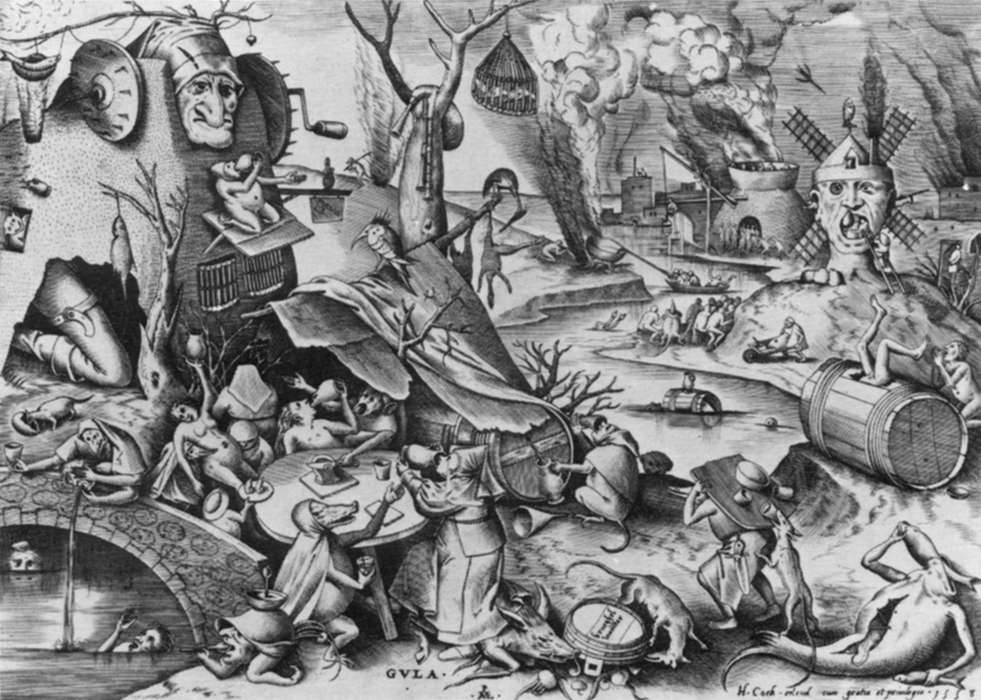 | |
| Courtsy: Wikimedia Commons a painting, Gula (Gluttony), by the Flemish painter Pieter Bruegel the Elder |
This is Visceraland! The land of gluttons! The land of voracious appetite; appetite for food, money, human flesh and soul, other material possessions, but not ideal ones. In the land of the gluttons there is no place for thinking, contemplations, inventing, discovering, having fun… there is a constant shortage of time for other, ‘extraneous’ activities except eating, grazing, munching, draining human blood. All the other activities, except those related to food and the belly, ingestion and egestion, belching and farting,…etc are extra-curricular activities. They have no time for their brain but they extremely care for their brawn; fond of and hypochondriac about the belly.
In the land of the gluttons, there is cannibalism; an occult cannibalistic ritual, a secret ritual of eating the human being: his soul and flesh. Stealing is normal, killing is acceptable, robbing is a virtue, for the extent to which ideas will be entertained is almost null. Everything related to the temporal, rudimentary pleasure in foods, mostly junk, is the major concern; hence, the primeval agenda.
The people in the land of the gluttons think that life is nothing more than eating more now than any other time. They are people devoid of being, a well-structured, mentally confident personality [save that they are confident in the belly]. Their brain is a product of their prosaic struggle for survival in their own non-sense sphere of influence; they call it the swinosophy. Belly grows at the cost of brain. Even the opposite of belly, the back has no sense for them; for them non-sense, but less non-sense than the brain.
Life in the land of the gluttons is a life led by present-mindedness: forget yesterday, eat today, never bother about tomorrow; literally stating, ‘put no faith in the morrow, seize the day.’ Their tactical conclusion is, we hate yesterday because it is a memory of a time when we have already spent snatching but it was a time when we had less belly-filling food than today. In the same accord they care not about tomorrow for they may be side-tracked from their present state of gluttony, of chasing junk food, ceaseless voracity due to their naïve sense, thought of time and space without the brain. They do not need thought; they rather need toilets, where they could dump their physical and philosophical absurdities.
If you are to be a stranger in Visceraland, where utmost respect is given to the belly and you are a person of anti-gluttonic deviance syndrome [AGDS], they will definitely eat and crush you alive. They do not want people like you; they do have a firm belief in the very idea that, there is no need for people who tend to or really think; rather they are interested in obese, stinky swinophilias. They love people from the swamps, the swamps of left-overs, junkies. They are not producers of any sort; instead, they follow a policy of scorched food incessantly scavenging on whatever is in their way, and mostly are fond of and obsessed with carcasses; human carcass is their favorite.
At the gates of the city of the gluttons, Swinopolis, in which gluttons have controlled and ruled with ruthless swinocracy, you will find a common signpost written in big, shiny letters; the letters are made 99% out of food and 1% wooden board.
And beyond the signpost, there are certain ‘constitutional rules’ the swinocrats have formulated for their convenience:“Life is nothing more than snatching, eating, regurgitating and erasing your digestive memory for your next mission of belly foencoding [food encoding]; that is all there is to life.”
The 10 Commandments of Swinocracy of the state of Visceraland
Rule #1 Stop thinking and start stinking.
Rule #2 Thinking is bad and stinking is good.
Rule #3 Producing more excreta is better than producing more thought.
Rule #4 Thought is crime; viscera is a virtuous blessing.
Rule #5 Gluttony eating every sort of unsorted, unidentifiable, junk food is a virtue; thought, thinking, interest in such stuffs as philosophy, science, technology, politics…is an anti-thesis to swinosophy and swinocracy.
Rule #6 In order to spread our swinocentrism, we need more Swinosophic ‘Schools’.
Rule #7 Love food as your own soul; hate thought as it is anti-swinocratic.
Rule #8 Our mission is to create an International Brotherhood of Scientific Swinocracy, of Orthodox Gluttons.
Rule #9 Belly is the mind of our beloved swinocrats and advocates. There is no need for brain. Brainlessism is the only way forward.
Rule #10 The worst of life of man is that of a life of man in cerebrocracy, where mind is the source of thought; the best, pleasurable, adventurous life of man is only to be found in our swinocratic state.
These Ten Commandments are the core tenets of the Swinocratic government with its international relations being governed by the principles of international stomach voracity and digestive viscera; hence, Swinism.
Turning to the main tip of the essay, where do you think you are in, in the school of cerebrocracy or in the league of swinocracy? Are you someone who prefers thinking or someone who constantly stinks? Are you a humanoid or a human endowed with intelligent being, personality, and identity of your own? The answers are up to you as ‘there are no rules as to what the creditor should wear’. But make a conscious choice as long as you stay awake and alive. Once your eyes are convinced to sleep, they may not be confident enough to stay awake and alive.
I don’t think you will bear the burdens of being submerged and sunk by your vices, gluttony in this case; you are a unique creature capable of having a virtue, aspiring, thriving, loving, caring, inventing, discovering, starting a revolution of either ideas or materials, shaping your mind and attitude. You were not brought up to live like a ruthless, brute, ferocious, voracious beast; you have virtuous principles out of your philosophical apotheosis and thriving. Your labor of thinking has given you the privilege of being the master of the whole kingdom of nature, in relative sense. So, how could you be led by your belly than your mind? How on earth would you let yourself be transformed into a voracious, viscerotonic zombie, whose sole aim is to snatch, to kill, and to feed on its prey without discrimination? You should and must stop this right here and now. Or else you will soon become an inferior, consumption-laden beast yourself. Don’t forget that your diligent brain needs a microscopic amount of food while performing its massive thought tasks of bodily and spiritual governance while your belly is an ancillary body to your brain, whether to digest, assimilate, egest or else it is given commands to perform from your low-food consuming brain. Your brain is who you are; your belly is what makes what you are, makes you a physically existent, moving object like any other matter. Bear in mind that your belly is a means not an end.
Get out of the vicious cycle of swinism right here and now and start living a virtuous life of human beings than beastly humans! Stop stinking and start thinking!

Romance is maybe not yet totally dead, but its forthcoming death is signalled by object-gadgets which promise to deliver excessive pleasure but which effectively reproduce only the lack itself.
The latest fashion is the Stamina Training Unit, a counterpart to the vibrator: a masturbatory device that resembles a battery-powered light (so we're not embarrassed when carrying it around). You put the erect penis into the opening at the top, push the button, and the object vibrates till satisfaction … The product is available in different colours, levels of tightness and forms (hairy or without hair, etc) that imitate all three main openings for sexual penetration (mouth, vagina, anus). What one buys here is the partial object (erogenous zone) alone, deprived of the embarrassing additional burden of the entire person.
How are we to cope with this brave new world which undermines the basic premises of our intimate life? The ultimate solution would be, of course, to push a vibrator into the Stamina Training Unit, turn them both on and leave all the fun to this ideal couple, with us, the two real human partners, sitting at a nearby table, drinking tea and calmly enjoying the fact that, without great effort, we have fulfilled our duty to enjoy.